The Monetary Morality Play
Sometimes high interest rates happen to good people

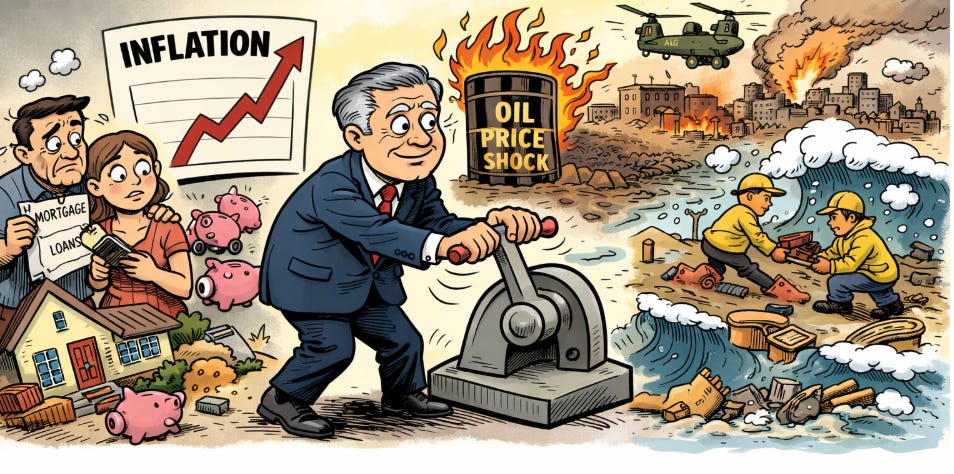
Paul Krugman infamously wrote that economics is not a morality play. Sometimes bad things happen to good people. And sometimes that is simply the economically best outcome - it is not possible or desirable for every virtue to be rewarded and vice punished.
But the desire for morality play logic gets applied to monetary policy decisions all the time. We see a surge in inflation and people rightly get upset. Prices are already rising, and then policy makers respond by raising interest rates. This is, many contend, cruel or unfair. Households are already hurting through no fault of their own! Why punish them even more with higher interest rates?
But the reality is that central bankers’ goal is not to punish households, but to prevent an even worse outcome. Persistently high inflation is economically costly (and politically damaging). If policymakers do nothing, the eventual adjustment can be far more painful.
In other words, policymakers are often choosing between a bad outcome and an even worse one.
What I find strange is that this sort of morality tale seems particularly pervasive in discussions of monetary policy but in many other areas of policymaking, people are more than happy to let it go.
After the 2010–2011 Queensland floods, the Australian government introduced a temporary flood levy to help pay for the cleanup. This was treated as an almost completely unremarkable piece of policymaking. People had suffered a costly setback from a random natural disaster. Obviously the cleanup had to be paid for, and adding a temporary top-up to tax bills was a fairly common-sense way to deal with the situation.
One could easily imagine framing the policy in moralistic terms: we have already been hit by floods and now we are being hit by higher taxes as well. But that argument never really took hold or was even widely voice. People seemed to appreciate that while the floods were unequivocally bad responding to them required resources. The government needed to spend money on the cleanup, and any way of funding that spending—higher taxes, more borrowing, or cutting other services—would involve trade-offs. A temporary levy was simply judged to be the least bad option.
This sort of thing happens all the time in policy situations. A crime wave happens and now we need to pay more for police and prisons!? A epidemic breaks out and now the hospitals are closing elective surgery!?
That is more or less exactly what is occuring with the current surge in global oil prices For an oil-importing country like Australia this is effectively a negative shock. Energy becomes more expensive, production costs rise, and the country is simply worse off in real terms. That deterioration tends to show up as some combination of higher inflation and lower output.
There is no policy that can eliminate that loss. The country is poorer.
What policymakers can do is decide how to respond to that shock. One reasonable response is to tighten monetary policy at least somewhat to prevent the rise in costs from feeding through into persistently higher inflation. Doing so may slow the economy somewhat in the short run, but it reduces the risk of a much larger inflation problem later.
To my superficial eye the logic is very simple. Government policy is responding to a negative shock in order to produce a bad outcome instead of an even worse outcome.
And yet the public reaction tends to be very different. People are generally comfortable paying higher taxes to fund disaster recovery, but many become ropeable at the idea of higher interest rates to keep inflation in check following a negative shock.
I am not entirely sure why monetary policy seems to operate under a different set of intuitive rules. But it clearly does.
Great piece. I'd add one thing to the puzzle: it's not just that the public underweights inflation – they actually hate it, and vote governments out over it. What they resist is the cure.
The difference, I think, is attributability. When inflation hits, it feels like something that's just happening – diffuse, authorless. When the RBA raises rates and your mortgage repayment jumps $400 a month, you know exactly who did that to you. There's a decision-maker, a date, a press conference.
That asymmetry in blame is what makes monetary tightening politically toxic in a way a flood levy isn't. The levy is a response to an obvious disaster with an obvious price tag. The rate rise is an inflicted harm in service of preventing a hypothetical one.
Which is also why the "good times economists" you'll always find calling for cuts are so influential – they're not creating the bias, they're exploiting it. It's always easy to be the commentator saying the central bank is hurting families, because the central bank's action is legible and blameworthy. The counterfactual of entrenched inflation is invisible.